
Learning analytics
What is learning analytics?
The goal of learning analytics is to provide means, tools and methods for monitoring the progress of studies and anticipating possible learning difficulties. A particular area of interest is the guidance of studies and automation of support for learning and teaching. These methods aim to achieve tested, justified and ethically sustainable impacts on learning, teaching, guidance and administrative processes.
In learning analytics, it is typical to build models from existing data. For example, by examining the annual accumulation of credits from sufficiently large data set, it is possible to predict the credit accumulation of students for the entire academic year well in advance in the coming years. Such a model enables early reaction and possible correction of the situation when corrections can still be made.

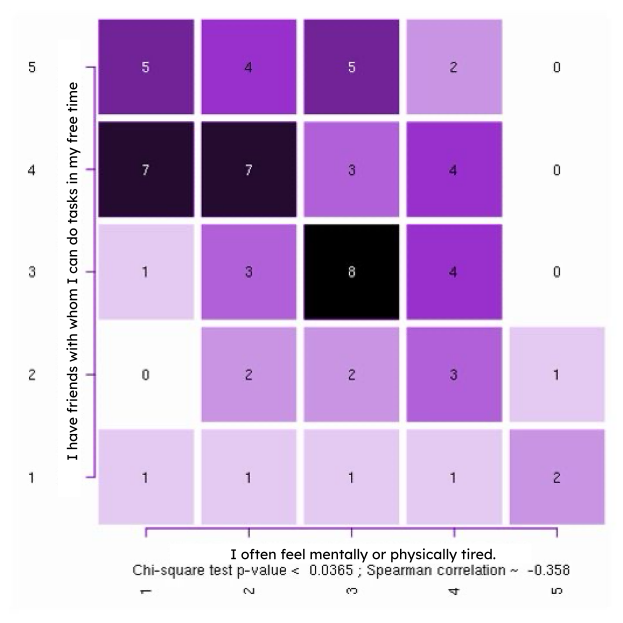
Surveys can be effective in collecting the data required by learning analytics tools, especially if the survey data can be combined with data collected by other means (for example, data automatically collected from learning systems or sensors). However, even simple surveys can yield important results. The accompanying graph combines two questions from a survey to measuring students’ study habits. As can be seen from the image, students who have friends to do assignments with report feeling mentally or physically tired less often. Based on the image, it is therefore worth investing in promoting grouping among students.
Continuous assessment and comprehensive collection of course performance enables the construction of a model that predicts course performance. The following image shows the situation of an eight-week course in the second week.
The balls in the image represent each student in the course. The balls are color-coded according to the grade the students achieved in the course. It is noteworthy that already in the second week, the model can identify 80% of the students who will not pass the course.

ViLLE automatically identifies students’ learning difficulties in different areas of mathematics based on data collected from their performance.
According to research, the algorithms used by ViLLE identify learning difficulties as effectively as the MAKEKO test. However, automatic analytics allow real-time information to be presented to the teacher at any time without separate testing.

How do we utilize learning analytics?
Our research focuses on digital learning and learning analytics in a variety of ways. By utilizing learning analytics, we can, for example, identify learning difficulties. The information generated through the research is used to develop the ViLLE learning system and its materials.
ViLLE’s ready-made teaching materials, learning paths, are developed in collaboration with teachers, using learning analytics. The teacher can monitor the students’ skills from the course analytics view, and can offer the student individual support.